Image
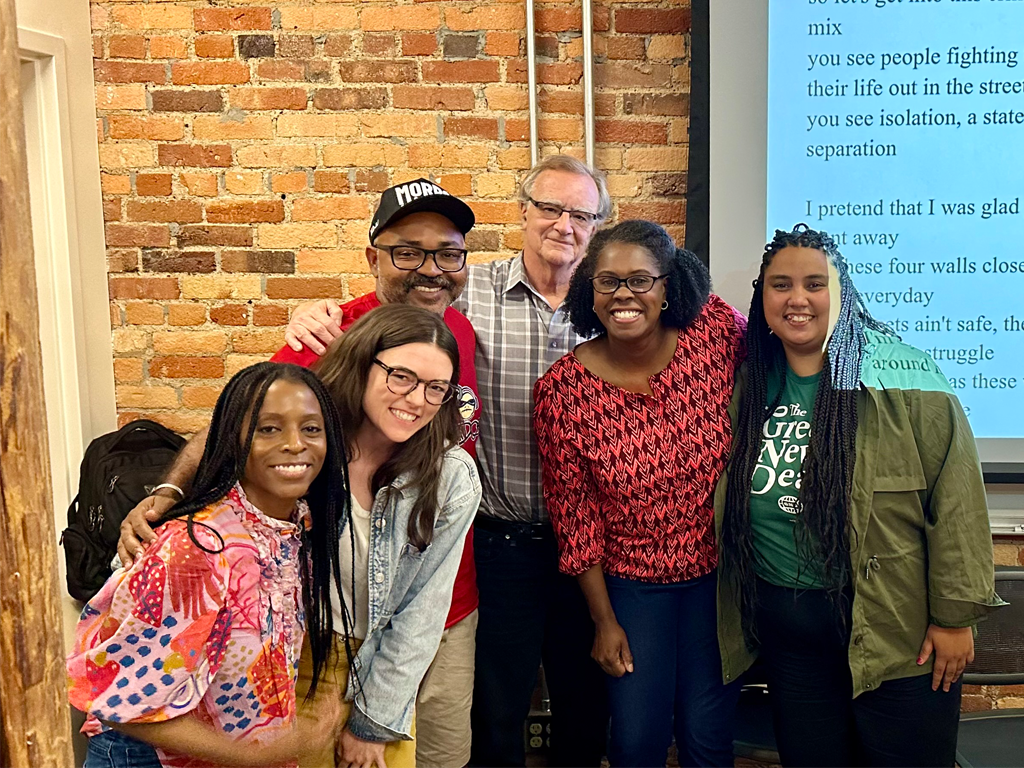
This project is a collaboration with Duke Bass Connections.
Articles:
Brazilian Activism, Culture, Education, and Religion, with a Hip-Hop Soundtrack
Hip-Hop as Education and Inspiration in Brazil and the United States
Brazilian Hip Hop Occupies Classroom! Dudu de Morro Agudo visits Durham, Asheville, and Athens, Ga.
Angola and Brazil have a deep connection forged by the Transatlantic Slave Trade. The earliest enslaved peoples brought to Brazil by the Portuguese came from West Central Africa. These Africans brought with them their languages, cuisines, religions and expressive practices that had a foundational and lasting impact on Brazilian culture.
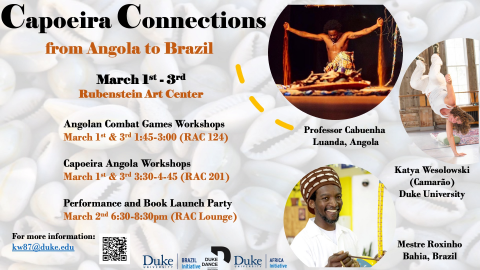
This event explored the connection between Angola and Brazil through the combat game of capoeira. A blend of fight, dance, ritual and percussive music, capoeira has roots in Angola, was developed in Brazil, and today is globally popular. This three-day event included movement and music workshops in Angolan combat games and capoeira with guest artist-teachers from Angola and Brazil, as well as a book launch party and performance. All events are free and open to the Duke and wider community. For more information email kw87@duke.edu or visit https://www.katyawesolowski.com/events
Katya Wesolowski, Lecturing Fellow in Cultural Anthropology and Dance, recently released a memoir with the same title, published by the University Press of Florida. Read more about it here.

The Global Brazil Humanities Lab was an innovative teaching experiment that entailed developing new interdisciplinary methods to learn about Brazil, not just in an area studies context, but primarily as a global actor, especially related to the overarching themes of culture, the environment, and politics. The lab was funded by a grant from the Mellon Foundation and supported by the Franklin Humanities Institute at Duke.
